Sunday, August 30, 2020

I'm Finally Satisfied (aka The Battle is Over for Now)


Pre-pandemic, my MacMini updated to iOS Catalina. Apparently, Hauptwerks, the software that powers my organ wasn't supported for the new OS. I tried to upgrade from Hauptwerks 4 to Hauptwerks 5, but found out I would have to buy a new "perpetual" license as my old "perpetual" licensed dongle had lost its perpetuity. I decided not to upgrade because I am ever cheap. I grabbed the old PC tower that used to run my organ software and voila, I was up and running again.

Having a full size practice organ in the home is not as standard as I once believed. I grew up in a home with two pianos and a Hammond organ. That was what "normal" was to me. Upstairs, my mother taught piano lessons on a Baldwin Spinet, but downstairs, I practiced on a Hammond with accompanying tone cabinet (rotating leslie speaker) and an Steinway upright grand with ivory keys. I had no idea how spoiled I was. 


 Last week, as I was telling my mother I had put upwards of $4,000 into my organ upgrade, she told me that in 1967 she purchased the Hammond plus the Steinway for $1999. In 1967, that was the price of a car.

 Early in my married adult life I've mustered along with several "fun organs". The small organ pictured here is an old Whirlitzer I owned. These were my desperation organs. I was able to use them to practice hymns, but I had to transcribe as I played to keep the pedals within the single octave available on the short pedalboard. 

My husband hated having an organ in the home (to be fair I also had the upright grand and a digital keyboard). He even convinced me to let him take a small organ to the dump once when we were "rearranging the furniture". It broke my heart to see it thrown in a bin. Once I was divorced I realized "my house, my rules" and I vowed to make room for a full-size organ. The problem then wasn't space, but money.

My search for a practice organ led me to an older woman who, along with her husband, was preparing to go on a full-time mission. She had to let go of her organ and I was able to buy it for $150. I got it for Christmas in 2011.

With a full size organ in my home, I was able to enroll in organ lessons at the local university. It was through organ lessons that I learned about the midi driven Hauptwerk Software. I was super intrigued. My new-old organ (which was built in the 70's) had electronic components that were past their prime. Stops and notes gave up the ghost regularly. As much as I researched, I could not find parts or professionals to repair the organ. Certain stops and keys just wouldn't work. The organ had been manufactured before midi technology. But (due to my IT background) I figured, if I could find an organ capable of running Hauptwerk, it would, in the end, be just another computer I could maintain and repair. I began looking for a computer with midi capabilities.
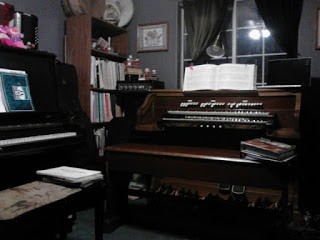
In July of 2012, I had a bit of money and a bit of an opportunity. Someone had listed a Hauptwerks Organ on ebay for $500. I rented a small U-Haul and my teenage boys drove six hours to a rural town in Northern California on sketchy backroads, got trained on how to set up the organ, drove it home and set it up for me.

This organ was exactly what I was looking for. I downloaded all of the free Hauptwerk sample sets I could that would run on the free version of Hauptwerk, and I soon had German, French, English, Modern, Romantic, and Baroque virtual organs. Not only had the seller set up the manuals as midi inputs, he also had set up mechanical keypistons and stops as midi controllers. He had Frankensteined parts from at least two old organs. Based on wood coloration, the bench and keyboards came from one organ, and the console and pedalboard from another. My organ lessons took on new hope. I was able to practice three hours a day while being happy with the sound and touch of the organ.


Ok, full disclosure, the more I practiced, the more I noticed -- things. The upper manual had keys that would stick, and the pedals would sometimes sound two notes instead of one. But what did I expect? This thing was literally soldered together with thin wire and ribbon cables.


Then came the pedalboard issues. The pedalboard band springs had been screwed into the old, compromised wood of the pedalboard. Three hours a day of practice took its toll. The screws began to pull up. I replaced all of the screws with bolts that I threaded through the bottom of the board and capped with a locking nut.

When the pedals started double sounding, I tightened the nuts. I also reinforced weak wood (where the bolt would pull through) with any metal I could find. A couple of band springs lost their spring. At one point, I shoved a kitchen knife under a band spring to keep the note from sagging and sounding eternally.

I had to resolder manual keys whose wires had come detached. And four or five times a year (usually after a power outage) I would tear the whole organ apart and pray that God would show me how to get the midi controller boards working again.  I kept sockets and a socket wrench in the organ bench. The organ and I kept up this battle for 8 years. 

Eventually I gave up on the thumb pistons and stops ever working again. As long as I had my keyboards and pedalboard, I could continue to practice. In the midst of the pandemic, shortly after I started back to work, we had another power outage. I spent the good part of two weeks trying to get the organ working again. I was able to get my Greats back, but no swell or pedal board. I had been trying to buy midi controllers that accommodated the 34 pin ribbon cables since the pistons and stops had gone out. I tried again. No luck.

I figured I could learn to rewire the all the boards to fit newer midi controllers (and still have the sticky keys and a decaying pedalboard) or I could finally put real money into my instrument. Even God knows you can't rely on miracles forever. He also wants us to work and sacrifice. Prayers helped me realize that I now have money and it's ok to spend money on nice things for myself. Not only could I buy quality parts, I could buy the parts I'd been drooling over for the last decade - the ebony and cherry wood manuals from Midiworks.ca as well as a fully midi pedalboard. Thinking everything would be plug and play, I anticipated my organ would be back up and playable within a week. Since I was working on hardware upgrades, I decided to focus on software as well as upgrade my speakers and recording capabilities.


I hate to make this post overly long, but I think maybe it might help some organist somewhere? I want to mention that since Easter, I have been trying to record weekly Sabbath prelude music. Playing the organ is my job at church. With the pandemic, and not being able to attend church in person, recording and posting prelude helps me with my personal worship. And while I realize that neither man nor God need my prelude, I need it. My home needs it. I practiced for quite a while for my Easter prelude. It was my first and only time doing a Facebook live and while it was not perfect, I was happy with the music selection and my performance.

 I was unhappy with the recorded sound, however. I was recording using a webcam, a pc and a microphone. I have found that Hauptwerk sounds better on a Mac. But I was still avoiding the inevitableness of having to purchase Hauptwerks 5. But since I was upgrading the organ, I figured I would fix everything. I had been using a PA system as speakers for my organ. My kids were desperate to get the speakers out of the living room, due to their size and "ugliness". They suggested getting a soundcard for the PC and connecting to a soundbar with woofer.


The keyboards arrived and fit snuggly into the cabinet where the older keyboards had sat. I had a beautiful manuals only computer and recorded prelude written for manuals only that week. Then the pedals arrived and sorrow set in. Apparently the full pedals I had before were not to AGO specifications. And the new set was too wide for my organ console. I set everything up on a table so I could practice while I pouted and considered my options. I would have to cut into my organ console (cabinet) - the one thing I loved about my old organ. It's antiqueness. It's history of being a console for a pipe organ in a church.


But it couldn't be helped. The cabinet would be useless without the components and the components needed somewhere to go. The kids and I gutted the console, sanded it down, refinished with Sedona Red stain so that every piece matched. And then we made the heart-wrenching cuts into the cabinet. Once everything was back together, I felt better. The organ looked good - but I still wasn't done.

The sound blaster improved the audio coming from the PC computer, but the soundbar and woofer combo could not handle the range and polyphony of the organ. If I played the pedals too low or played too many notes, the woofer rattled. I purchased a Scarlett 2i2 external sound mixer, but it wasn't compatible with Windows 7. So many trials and errors.

I went back to the Catalina OS MacMini and installed a trial version of Hauptwerk 5. I routed the sound through the Scarlett 2i2 to a Fender bass amp I had sitting around. It was a great sound for practicing. For recording, I looped from the Scarlett 2i2 back into the MacMini mic input jack and was satisfied with the results.

I have a touch screen monitor that I use for pressing virtual stops and pistons. This monitor works for a PC but not for a Mac. I purchased a program that allows Macs to use the touch capability of a monitor. I paid for the upgrade to Hauptwerk 5. It was slightly cheaper than I anticipated as they gave me credit for having already purchased the perpetual license for Hauptwerk 4. Hauptwerk is pushing users to upgrade to Hauptwerk 5, not for increased functionality, but for increased security for the developers of sample sets. I guess some hacking was going on. New encryption is used with the virtual organs, so several of my old organs don't work with the new version.

I am just finishing up with the process of loading organs. The only organ I am sad about losing is the Composite English Organ that Les Deutsch of nightbloomingjazzmnen.com assembled. It has the best Diapason stops. He indicates that it will work with Hauptwerk 5. I just haven't been able to get it to go as of yet.

Still I have plenty of organs to play. I am listing them below as well as resources where they can be found.

 One final shout-out. In the midst of all this upheaval and revision, I attended the BYU Organ Workshop online. I was uplifted, inspired, and encouraged. I've tried adopted a few tips I picked up. One that involved technology, includes the app ForScore. I have been using iPads to read music for years, but what I didn't know was that if you pay $10 a year, you can get the pro version of ForScore which includes gesture page turns, meaning, all I have to do to turn the page is turn my head. This is amazing and has been a great tool. I've been using my daughters 12.9 inch iPad 11 pro as my iPad mini has a rather small screen. Maybe Santa will bring me my own large iPad? 

 Below is the list of reliable Sample Sets I have installed. I have three relatively cheap organs that I have purchased (Schantz 3-manual-$150 ,St. Eucaire-$150, and Menesterol-$70). The others are available free of cost.

  • Azzio (small free organ)
  • Bakats demo with good functionality (free )
  • Bureau (free)
  • Cracov
  • Dluga Koscielna
  • Doesburg, St. Marini Walcker, Demo - not all stops available
  • Enigma
  • French Harmonium
  • Friesach Extended
  • Ghent Carillon
  • Giubiasco (has Zimbelstern stop)
  • Green Positiv (Small - one keyboard)
  • Groningen Demo
  • Groton
  • Melbourne Town Hall (trial) few stops available
  • Scots (trial)
  • Jeux D'orgues 2 Stiehr Mockers
  • Kanta
  • Late Romantic Composite
  • Les Cracov Extended
  • Les Pitea 945
  • Les Expanded Schantz (Purchased copy of Schantz)
  • Little Waldingfield
  • Menesterol (Purhased)
  • Menesterol extended
  • Hammond Model 945 (has chime stop)
  • Paramount Theater Organ 310
  • Piacenza Demo
  • Pitea Extended
  • Raszczye
  • Rotterdam
  • Saint Eucaire Cavaille-Coll (Purchased)
  • Saint-Jean-de-Luz
  • Schantz 3 manual (purchased)
  • Skrzatusz
  • Sonus Paradise Great Baroque
  • St Mary Le Bow
  • St. Michel en Thierache
  • St Pons
  • St Annes Moseley (comes with Hauptwerk)
  • Strassburg
  • Sygsoft Harpsichord
  • Szczecinek
  • Velesovo (limited stops)
  • Walker1747
  • Williams Expanded Schantz
  • Williams Lew Jeux D'Orgues

Resources

https://organareginaecaeli.wordpress.com/best-free-hauptwerk-sample-sets/

https://piotrgrabowski.pl/

https://virtualpipeorgans.wordpress.com/sample-sets/free-sample-set-producers/

http://www.sonusparadisi.cz/en/blog/category/free-stuff/

https://almorse.net/content_freeorgans.html

https://www.lavenderaudio.co.uk/organs/smb/smb-samplesets.html

http://nightbloomingjazzmen.com/NBJ_Organ_Software.html


Sunday, August 2, 2020

Say Hello to my little (organ) friend

I miss my sister. Especially when I blog. The funnest part of posting on line for me was waiting for her comment. She always had the most genuinely kind things to say to me, as if my interests were fascinating to her. A kind word from Judy was a rare and treasured jewel, because she was the most frank and outspoken person I know. 


(apparently the visual link to the youtube video of my new organ isn't showing up on Android so the above is the direct link)

On this the Sabbath day, and on a day that pre-pandemic would have included Fast and Testimony meetings in Church of Jesus Christ of Latter-Day-Saint chapels across the globe, I want to share something that Judy, in her frank and outspoken way, taught me. When Judy was a student at Brigham Young University, she attended a campus ward. One Sunday during fast and testimony meeting, a young co-ed stood and bore her testimony of a miracle she had witnessed. When this young lady had gotten in her car that morning to go to church, her car wouldn't start. Her car had been struggling for a couple of weeks, but that morning, it would not even turn over. After trying several minutes to get the car to start, the girl returned to her apartment, went to her bedroom, got down on her knees and said a prayer. She then returned to the car and it started. The student thanked the Lord for his tender mercies.

My frank and down-to-earth sister was unimpressed with this miracle. She explained to me that we can't expect the Lord to miraculously fix our car every time we need to go somewhere. Sometimes we just need to fix the car. My tender heart was taken aback by this because I know that due to finances, sometimes we can't afford to get things fixed. I do not like to discount the faith-building experiences of others. 

It's been forty years since my sister told me that story with her critical analysis. Obviously the story had an impact on me because I am still pondering it. I thought on it a few years back as I read Trevor Noah's memoir, "Born a Crime." In his book, he tells how his mother drug him to church every Sunday. She drove an old unreliable VW Beetle. One Sunday, they got in the car and it wouldn't start. He turned to his mother and said, "I guess Jesus doesn't want us to go to church today." She responded, "Satan doesn't want us to go to church today and he has thrown this obstacle in our way. But we will show him that this won't stop us." They rode the bus to church.

And I am thinking about Judy's story today. I am thinking about the Lord's tender mercies and how he blesses us by helping us solve our own problems. A couple of weeks ago, my organ gave up the ghost. It had always been touchy. I bought it off a guy in California 15 years ago. He had frankensteined it from old parts from multiple organs as a DIY project. He sold it to me because he had built a better one. My organ ran on faith, five power supplies, and four midi boards. Each key was soldered to a wire in a computer ribbon cable. Every time the power went out, I would have to reconfigure the organ to get it to work. This could take days, and tears, and of course lots and lots of prayer.

Two weeks ago, when the power failed and I could not resurrect the organ, I remembered Judy's story. How long was I going to expect a miracle when I now have the means to repair the organ. I have the means to purchase quality parts - and that is a miracle as well. So I purchased two modern midi manuals (keyboards) and a new midi pedalboard. The manuals showed up a few days ago. The pedals will be here next week. I continue to praise the Lord for his goodness and that, like Judy, he is interested in what interests me, expects me to learn and grow, and work through the obstacles in my way.

Sunday, June 28, 2020

Thoughts on the Martyrdom of Joseph and Hyrum

One of my favorite themes from the musical Hamilton is encapsulated in the phrase, "who lives, who dies, who tells your story." As much as we like to look at history as a list of facts that never change, it is important to note, who lived, who died and who writes the story.

From an educator's viewpoint, I understand society's desire to spin simple tales of historic people who exemplify society's core values. For example, George Washington's honesty, Abraham Lincoln's belief that all men are created equal, and Columbus' divine discovery of America. Real people and real events are much more complicated. The stories we understand as children should not be the same histories we understand as adults. How we teach and understand history should and does affect how we act and react towards current events.

As I ponder on the martyrdom of Joseph and Hyrum, I reflect on the accounts I have read and the political leanings of the time. It took a long time for the Saints to get over the raw emotions brought on by the perceived unfairness of the violence in Illinois and Missouri. I have a great grandfather who was shot in cold blood in front of his family near Nauvoo. So many lost loved ones, and everyone lost Brother Hyrum and Brother Joseph...

From this time in history, hopefully we no longer hold the kind of anger that resulted in The Mountain Meadow Massacre, but what have we learned? For me, I hold onto the idea that I will help others. That I show love, concern,  towards those who worship differently than me. I show love and support towards those who are the victims of unfair policy or policing, and I show support towards who are leaving their homes to find a place of peace where they can raise their children.

It is the 176th anniversary of Joseph and Hyrum's death. I love you. I am thankful for all that you did for us and the world. I am thankful for your influence on my ancestors and your continued influence on me. Praise to the man who communed with Jehovah, death cannot conquer the hero again.


Sunday, April 19, 2020

When I consider how my light is spent

My favorite poem is John Milton's Sonnet 19: On His Blindness. It's the line "God doth not need either man's work or his own gifts; who best bear his mild yoke, they serve him best," that gets me every time. And I understand that the Lord does not need me, but I need him.

This week's lesson in the home centered church supported Come Follow Me curriculum is King Benjamin's address. He speaks to his people on service and what a blessing it has been for him to serve his people. He reminds his subjects that he is like them, "subject to all manner of infirmities in body and mind." He has labored to serve them and has not asked for riches in return. He famously tells his subjects, "I tell you these things that ye may learn wisdom; that ye may learn that when ye are in the service of your fellow beings, ye are only in the service of your God." Mosiah 2:17

I really can't say if me posting prelude online helps any of my "fellow men," but I know it keeps me practicing so that when we again meet together, I will be able to play my part. I need to serve my God any way I can. Each time I play prelude, I feel my love grow as much as if I were bearing testimony of My God and My Savior and their infinite love for us. Below Milton's sonnet is my prelude for this week.

Sonnet 19: When I consider how my light is spent

When I consider how my light is spent,
   Ere half my days, in this dark world and wide,
   And that one Talent which is death to hide
   Lodged with me useless, though my Soul more bent
To serve therewith my Maker, and present
   My true account, lest he returning chide;
   “Doth God exact day-labour, light denied?”
   I fondly ask. But patience, to prevent
That murmur, soon replies, “God doth not need
   Either man’s work or his own gifts; who best
   Bear his mild yoke, they serve him best. His state
Is Kingly. Thousands at his bidding speed
   And post o’er Land and Ocean without rest:
   They also serve who only stand and wait.”


Thursday, January 23, 2020

Decolonizing Star Wars


I am not a Star Wars Uber Fan, but in case you need it, my Force Number is B7203183000 (see accompanying Star Wars Fan Club Correspondence).


Star Wars fandom, for me, comes and goes. I was pretty sure I was forever over it, but then Disney+ released The Mandolorian and here I am taking a stand like 1981 called and wants my Force Number back. This time, however, the force feels different. Back in the 1900’s Star Wars was about the epic battle of good versus evil. To help the audience out, the western symbolism of white and black was used. Good guys wore the white hats (the rebellion, Luke, Leia, R2D2 ). Evil (Darth Vader) wore black.


I was raised a middleclass white girl. My father watched a lot of TV -- Gunsmoke, Bonanza, John Wayne Movies. I know he took the family to movies, but the only vivid memory I have of going to the movies as a family is of Dad taking us to see Star Wars in 1977. Finally, a western the whole family could enjoy! 

The original Star Wars was released 43 years ago. A lot has changed since then. For example, instead of a teenager, I am now a mother who has raised 7 indigenous children into adulthood. My children have impacted my thinking way more than I ever imprinted their thought process. For example – they don’t look upon Star Wars as the epic battle between good versus evil. They see Star Wars as a glorification of imperialist/colonial mindset on both sides. To them, the true heroes of the Star Wars saga are the indigenous peoples who survive the endless warmongering of the Republic and the Separatists/Empire.


Take for example, Mandalore. When the animated series, The Clone Wars, takes the viewer to Mandalore in Season Two (ep 12 – 14), Duchess Satine has taken a position of neutrality. She will not pick a side in a war that has nothing to do with her planet. After some violent acts by the terrorist organization “Death Watch”, the Republic – shadow puppeteered by the evil Chancellor Palpatine – proposes to send troops to Mandalore for their own protection. Duchess Satine declines the offer.
“Defending? You mean to occupy our home. You would trample our right to self-determination…You will turn our planet into a military target, which will bring the war to us.” The clone wars were a mess where two equally corrupt governments each headed by the same shadowy Palpatine fought over who was the most righteous. In the end, it was the indigenous populations of each planet that suffered and died.


That was a pretty lengthy backstory to get to the topic that has been rattling around in my brain since the Mandalorian came out. My children believe that Baby Yoda is a sacred indigenous baby. And it is not just my children. Native Instagram and the Native Meme Staff Carriers have gone into a creative frenzy adopting Baby Yoda into a plethora of cultural content. 

NBC News published an opinion on why Native Americans identify so well with Baby Yoda. In the article, which you can read in its entirety here, the author discusses the concept of  "indigenization". The lack of representation for Native Americans in popular culture causes the community to give certain aspects of pop culture an “indigenous spin”. While insightful, this article does not address the question of why Baby Yoda.


DGO Magazine published an article on the influence of Star Wars on indigenous art. You can read that article in its entirety here. It seems only fair that indigenous artists pull from Star Wars as we all know Princess Leia got her side buns from the Hopi.

 The DGO article also mentions that Star Wars was the first Hollywood movie dubbed into Navajo. So why we’re asking, “Why Yoda?”, we should also be asking, “Why Star Wars.” I’m going back to my answer of decolonization. I don’t believe that Native Americans need to indigenize Yoda. He is an indigenous life form. Here's hoping Season 2 of the Mandalorian will remain focused on returning Baby Yoda (aka "the child") to his people and getting his #landback.

Wednesday, April 17, 2019

The Cost of a Quality Instrument

Several, several, several years ago, my son saved up his money and bought a $400 keyboard/synthesizer to connect to his computer. Although he bought it new, it had some problems. It was under warrantee - the trick was, to get it repaired for free, we had to take it to a certified Yamaha repairman.
The closest repairman was in Las Vegas, a two hour drive away. When I went to pick it up, the repairman indicated it was fixed, but then threw some shade toward the instrument. He said, "the keyboard I use costs $4,000." I smiled and nodded, knowing I had just come from practicing a pipe organ in Vegas that probably cost $40,000.

I've been pondering the cost of one particular instrument this week. I was devastated by the news of the fire at Notre Dame in Paris. The destruction of the "forest" in the ceiling made of 12th century timbers is a loss to humanity. The timbers used for the ceiling are thought to be from 300 year old trees. Because of pollution and other global problems, trees don't grow as they once did - timber is not as dense.


In addition, the Cavaille-Coll organ installed in the cathedral is considered one of the premier organs in the world. While other historic and sacred artifacts were rescued from the burning building using a human chain, a pipe organ is not an instrument that can be easily moved.

The good news is that early reports indicate that the organ was not damaged by the fire or the water used to fight the fire. The bad news is that it has been covered in dust. Pipe organs are highly susceptible to dust. It will take an amazing amount of effort to restore this organ. The effort will be made. This instrument is priceless because of its history, its craftsmanship, and the generations of effort that have gone in to its upkeep and performance.

That of course has me reflecting on my own effort. I have not been practicing as I should. When I take lessons and have someone to whom I am accountable, I can easily practice two to three hours a day. When I have no one to report back to, I am lucky to get two to three hours per week. So I am disappointed that I don't play as well as I did, but I still love it so!

I love hearing a congregation sing boldly and with conviction. I love playing prelude and helping to invite the spirit into a meeting. At this point in my life, I have a pretty good collection of prelude to choose from. But just like looking into a closet full of clothes and saying, "I have nothing to wear," i often want to play a hymn for which I cannot find an appropriate arrangement. I am not the best arranger, but when I have an idea of what I'd like to do, I am sometimes stubborn enough to do it.

I want to play "Gethsemane, Jesus Loves Me" as prelude for Easter. It is one of my youngest boy's favorite songs. I was surprised that I couldn't find an organ arrangement for purchase, so I made a simple arrangement for myself. I'm super excited to sneak this into my prelude on Easter Sunday. And I thought I would share it with anyone else who might like to give it a go.

Gethsemane.pdf by on Scribd


The other Easter prelude I will use this year will come from Laurel Hunt Pederson's Easter collection (http://laurelhuntpedersen.com/organ-music/). I've mentioned her arrangements before. I particularly like her Easter Selection. I had thought of some Passion arrangements by William Herd (I played Herd for Christmas) but decided it would be a little heavier than what I would like.

A few months back, I also adapted a barbershop quartet version of Because I Have Been Given Much, to the organ. The harmonies are beautiful. I am going to share that in this post as well. Happy Easter everyone. Let's take this time to sing praises to our God, with our own voices or that of a great big organ!

Sunday, March 5, 2017

More than White Noise - Organ Prelude Edition


Once upon a five month period of time, I taught music in a Youth Rehab Center. The superintendent was chatting me up one day and asked, "Do you play music in your home?" I assured him we did. The kids are always practicing. I'm forever practicing. And then don't get me started on family band.

The superintendent then explained to me that his son is married to a "Mormon" girl and the in-laws' house is always quiet. I defended the faith by telling him that even in my parent's home music was always being played. My mother taught piano. My sister's played stringed instruments and sang. We all practiced piano and organ. The summer months were spent learning ukulele, guitar, and accordion.

I didn't realize this wasn't what he meant regarding music and quiet until he said, "From the time I get home until the time I leave either a radio, record player, or tv is playing."  When compared to this, I suppose one could call my home quiet.

Don't get me wrong. This isn't one of those blogs that is anti modern music. My household has a family Spotify plan. I personally have an Amazon Prime account with a good collection of music from classical to Broadway to Rock and Roll. In my home you may at anytime hear Northern Cree or Hamilton or John Denver or Nahko and Medicine for the People playing through my large screen television or on somebody's bluetooth speaker. But it is not on all the time.  We have music on when we are cleaning, or dancing, or sharing. Still, more often than not, the family sits in quiet and visits, or reads, or studies.

In my opinion, the music my superintendent was describing isn't music at all, but white noise. It is a sound filler attempting to make a place seem less lonely, less boring, or less empty. In some homes white noise plays 24 hours a day. I've known people who can't sleep unless the tv is on all night long.


Story two. Many, many years ago, my family lived on a reservation. We moved into a 20 year old HUD home. This home had not been treated well over the years. It had the reputation of being a party house. Rumor had it that people only stayed in that house long enough to get kicked out. I found that if I left the TV on, the kids would start fighting. If I left the radio on as background noise, there would be contention in the home. But if I was very careful about what we watched and when we watched or listened, we could keep a very sweet spirit in the home.

OK. Now that we have a common platform of shared history, I am ready to start my rant about Organ Prelude music in LDS sacrament meetings. Wait -- one more story. I was sitting in a fast-and-testimony meeting where an older woman was testifying about her grandchildren. She told them she was taking them to church. As their parents also took them to church, the grandkids were unsure which church she meant. "The eating church or the singing church?" they asked. I was sorely disappointed to discover that the LDS church was "the eating church".


Over fifty years ago, a member of the Quorum of the Twelve, Adam S. Benion said, "In the Church we need better music and more of it, and better speaking and less of it." Music in most sacrament meetings has not improved since then. I fear that many members of a congregation view singing the hymns of praise as a duty rather than a delight. I further worry that many of these members hear organ prelude music as white noise -- noise to fill the empty space while members visit and concern themselves with worldly cares. Like my home that needed special care to invite the holy spirit, special care is needed from an organist to not only invite the spirit, but to also inspire the congregation to remove their worldly baggage and prepare themselves to receive a spiritual communion.

Organists are quick to point fingers at the congregation. Organists fulfill their duty and play, but nobody listens. From this despair I believe many organists downplay their efforts. Believing nobody is listening, it stands to reason that preparation is futile. I see many organists accept cold-read tunes played rote from the hymnal as appropriate prelude -- page 100 blandly followed by 101, then 102 and so forth. This breaks my heart. If the organist doesn't express a delight in playing the hymns, the congregation doesn't stand a chance.

I have found some success by playing hymn arrangements sparsely mixed with arrangements of hymns not found in the hymnal and hymn-like classical pieces. I don't play these pieces to show off my prowess. I play these pieces because I believe that my efforts matter. I believe that if even one person is moved by my prelude to ponder upon the hymn and to turn their thoughts heavenward, I have succeeded. The nicest thing that anyone has ever said to me is not, "You are a fantastic organist." It was, "I never see you stand and bear your testimony on Fast Sunday, but I hear you bear it every week as you play the organ."


And then there was today. A sabbath miracle. It was Fast and Testimony Meeting. The chorister chose to sing "Thy Spirit Lord has Touched our Souls," for the closing hymn. I have a great arrangement of that hymn. I wanted to play it right before the meeting started. I also planned to play it again as a refrain at the end of the meeting. This arrangement is difficult, but it has been in my repertoire for years. Because of its difficulty level, I counter balanced it with some simpler arrangements I have. At five (maybe six) before the hour, I began playing "Thy Spirit Lord". It was shorter than I anticipated. When it ended I still had three more minutes.

I let silence fill the chapel as I re-opened my easier arrangements. Just as the silence fell the Bishop walked onto the stand. The congregation settled. They thought the meeting was about to start. I played two more arrangements before the Bishop stood. The congregation didn't make a peep for the entire three minutes -- Reverence Sustained!!!

Fast and testimony meeting was sacred and special. I can't credit that to the organ, but it did pave the way.

For those who say, they don't have the skills to play more than the hymns for prelude, I am listing resources:


  1. http://www.organ.byu.edu/newldsorganist/ The LDS church is aware that many organists are pianists learning a new instrument. This site offers training, free arrangements, and simplified arrangements.
  2. http://laurelhuntpedersen.com/organ-music/ Laurel Hunt Pedersen is an LDS organist. She has arranged dozens upon dozens of LDS hymns. She has them in collections that can be used throughout the year. These are free downloads.
  3. http://www.sheetmusicplus.com/title/the-new-organist-volume-8-sheet-music/18638218 Jackman music has a series called The New Organist - Low Practice Prelude. There are 10 volumes in this series. These arrangements are easier than playing the hymns and they still pack a punch. They are currently selling for $7.16 a piece
  4. http://www.sheetmusicplus.com/title/postludes-vol-3-sheet-music/19512038 The arrangement of They Spirit Lord Has Stirred My Soul that I played today is a Kasen arrangement. This series of prelude books is simply entitled Postludes and is also available from Jackman Music.
  5. Hymn arrangements can also be created from the hymnbook. Try soloing a voice other than the soprano, tenor works very well. Play the tenor line on the Swell with solo voicing while playing the soprano and alto softly on the great. Play different verses with contrasting registration. Use reeds to invoke a sense of sacrifice and suffering, use string celestes on verses invoking the sublime. Use flutes for clear simplicity.

Above all, prayerfully prepare. Choosing and practicing prelude and hymns should take as much time as preparing a talk or lesson. Who among us would walk into their Relief Society or class of 12 year-olds, open the manual, and cold-read the lesson?